Insight
Why Section 106 Matters: Preserving VA’s Historic Healthcare Legacy
August 28, 2026
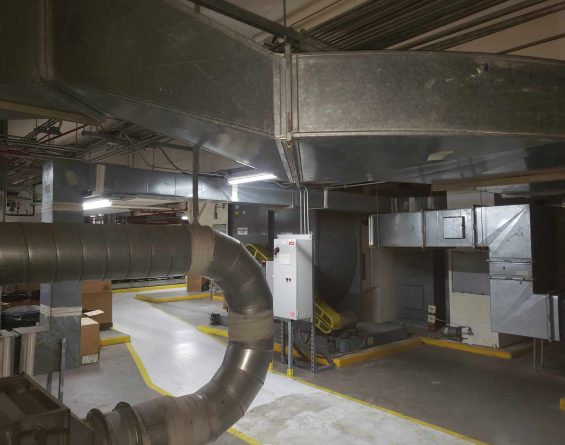
One of the most common assumptions in HVAC renovation projects is that if occupants are uncomfortable, the equipment must be undersized.
It is also one of the most expensive assumptions an owner can make.
On a recent Veterans Affairs hospital project, our team was asked to evaluate concerns that a newly designed replacement air handling unit (AHU-23) was too small to serve both its original zones and areas previously served by a separate air handling unit (AHU-47). Facility staff pointed to Building Automation System (BAS) airflow totals suggesting the system required significantly more airflow than the replacement design provided.
At first glance, the concern appeared reasonable. However, as is often the case in forensic engineering, the numbers told different stories depending on where they originated. The challenge was determining which numbers represented reality.
The Problem
The project involved replacing a decades-old air handling unit serving a large portion of a hospital’s radiology and administrative spaces.
The original AHU-23 was designed for approximately 17,150 CFM. The replacement unit was selected at 21,000 CFM with approximately 953 MBH of cooling capacity and 603 MBH sensible capacity.
During construction and commissioning discussions, concerns emerged that the replacement unit would be unable to support both its original service area and portions of a former AHU-47 system that had been consolidated into AHU-23.
The evidence appeared compelling.
BAS reports indicated VAV airflow totals substantially higher than what the replacement unit was designed to provide. Some stakeholders concluded the design was fundamentally undersized and would require a larger air handling unit.
Had that assumption been accepted without investigation, the project could have quickly evolved into a costly redesign involving larger equipment, larger coils, larger piping, larger electrical infrastructure, and potentially significant schedule impacts.
Before recommending that path, we wanted to understand what the system was actually doing.
Follow the Air
The first step was to separate measured performance from calculated performance. Two independent testing and balancing reports showed airflow measurements at the AHU itself ranging between approximately 22,000 and 26,000 CFM. Yet BAS-derived VAV totals consistently reported only about 14,000 to 15,000 CFM reaching the terminal units.
That discrepancy immediately raised a question. If the fan was moving more than 22,000 CFM, why were only 14,000 to 15,000 CFM being accounted for downstream?
The answer was unlikely to be an undersized fan. Instead, it suggested that airflow was being lost somewhere between the air handler and the occupied spaces.
In forensic engineering, this is a critical distinction. An airflow deficiency at the space does not automatically mean an airflow generation deficiency at the equipment.
Field Conditions Matter
Site investigations quickly revealed that the system’s history was more complicated than the drawings suggested.
Field observations identified multiple conditions capable of reducing delivered airflow:
The contract documents themselves acknowledged leakage concerns and required repair of leaking ductwork within portions of the distribution system.
Additional field investigations later identified outside air and duct routing conditions that differed from assumptions made during earlier project phases.
In other words, the system was behaving exactly like many older hospital HVAC systems behave after decades of modifications, tenant changes, equipment replacements, and deferred maintenance.
The problem was not simply a piece of equipment. The problem was the system.
The Danger of BAS-Based Sizing
Building automation systems are extraordinary operational tools. They are not always reliable design tools.
Modern BAS airflow values are often calculated from differential pressure measurements and programmed K-factors rather than direct airflow measurement. Small calibration errors can create large discrepancies when dozens of VAV boxes are aggregated together.
Additionally, BAS values frequently represent commanded airflow rather than verified delivered airflow.
In a system experiencing leakage, excessive static pressure losses, closed dampers, or distribution restrictions, the BAS may indicate airflow targets are being met while occupants experience the opposite. This project demonstrated exactly that condition. Measured airflow at the fan significantly exceeded reported airflow reaching the VAV network. Had we sized replacement equipment solely around BAS totals, we would have designed a solution for the symptom rather than the cause.
Another Surprise: The Building Had Changed
The forensic review uncovered a second issue. Many assumptions regarding AHU-47 were rooted in historical operating conditions that no longer existed.
Areas once associated with data-processing and technology-intensive functions had evolved into typical office and administrative spaces. The original ventilation and airflow expectations reflected an earlier era of building use. This is a common challenge in healthcare facilities.
Over several decades, departments move, functions change, and equipment loads evolve. Yet airflow assumptions often survive long after the spaces they were intended to serve have disappeared.
When evaluating an existing facility, engineers must distinguish between historical requirements and current requirements. Designing for obsolete loads can be nearly as problematic as designing for inadequate loads.
Engineering is About Eliminating Variables
Rather than immediately recommending larger equipment, our team proposed a more disciplined approach.
First, correct known distribution deficiencies.
Second, verify actual airflow performance through testing and balancing.
Third, evaluate any remaining deficiencies using updated load calculations and current occupancy assumptions.
The recommended corrective actions included:
Only after those variables were eliminated would it be appropriate to determine whether supplemental equipment was truly necessary.
That sequence matters.
Too often in our industry, equipment replacement becomes the first solution considered rather than the last.
The Broader Lesson
The most valuable lesson from this project had little to do with AHUs, VAVs, or hospital HVAC systems.
It was a reminder that engineering decisions should be based on verified physical evidence, not assumptions.
When multiple data sources disagree, the engineer’s responsibility is not to choose the most convenient answer.
The responsibility is to determine why the answers differ.
In this case:
Only by evaluating all of those pieces together could the true picture emerge.
That is the essence of forensic engineering. Not proving someone right or wrong. Not defending a design. Not validating a preconceived conclusion. Simply following the evidence until the system explains itself.
And sometimes, the most important engineering discovery is realizing that the problem everyone is trying to solve is not actually the problem at all.